BACHELOR OF DESIGN /
INTERIOR DESIGN

INTERIOR DESIGN OVERVIEW
The Bachelor of Design with specialisation in Interior Design is a degree unlike any other in Australia, built for those who want to be at the forefront of the interiors industry. Combining spatial planning, materiality, styling and business acumen, this course equips students with the skills to design and deliver commercial and residential spaces that respond to how people actually live and work. Graduates leave with a strong technical foundation, a refined design sensibility and a portfolio that speaks directly to industry.
WHY STUDY INTERIOR DESIGN AT WHITEHOUSE
WHAT YOU'LL LEARN
Through hands-on studio projects across residential, hospitality, retail and commercial interiors, you'll develop the creative and technical skills the industry demands.
- Design and critical thinking, from sketch through to fully rendered perspective
- Sketchup for quickly turning design ideas into visual, buildable concepts.
- Industry-standard Autodesk Revit training for 3D modelling, technical drafting and documentation
- Adobe Creative Cloud: Illustrator, InDesign and Photoshop
- Technical documentation covering interior construction and regulation
- Colour theory, composition and decorative product selection
- Space planning, drafting and technical specification
- Professional practice and project management
WHAT YOU'LL GRADUATE WITH
By the end of the degree you'll have:
- A professional portfolio spanning residential, hospitality, retail and commercial interior projects
- Confident technical drafting and documentation skills using industry-standard software
- The ability to take a client brief from concept through to construction-ready specification
- A refined design sensibility grounded in materiality, colour and spatial planning
-28.avif)
The Bachelor of Design with specialisation in Interior comprises 18 core subjects (Design Contexts, Digital Design + Illustration for Design) and 12 specialisation subjects (Interior Design + Interior Workshops), at a full-time study load this is delivered across 6 trimesters (2 years). To be awarded the Bachelor of Design, candidates must accrue an aggregate of 288 credit points, including satisfactory completion of all subjects.
The course is offered both full-time and part-time. At a full-time study load, students complete the degree in two years, undertaking five subjects each trimester as follows:
DESIGN CORE SUBJECTS
|:----|:----|:----|:----|
|DC1 to DC6|Design Contexts 1 to 6|Builds students' understanding of the cultural, historical and sustainable contexts that frame contemporary design, revealing the broader relationships between design practice and the history and culture of design, art and the marketplace. In the second year, the subject evolves into design in business, marketing and professional contexts.|6/36|
|DD1 to DD6|Digital Design 1 to 6|Develops the skills to create professional visual images and a design portfolio for both print and digital. Students use the Adobe Creative Cloud suite, including Photoshop, Lightroom and InDesign, to describe, develop and market their projects, mastering how digital media produces effective, meaningful communication.|6/36|
|ID1 to ID6|Design Illustration 1 to 6|Builds the knowledge and skills to create visual images across a variety of illustrative media and styles in support of design projects. Students explore hand and digital illustration to communicate design outcomes, developing a visual language that transcends words and equips graduates to work on a global scale.|6/36|
INTERIOR DESIGN SPECIALISATION SUBJECTS
|:----|:----|:----|:----|
|DI1 to DI6|Interior Design 1 to 6|Develops students' ability to interpret a design brief and generate a considered interior design concept in response, applying design theory, spatial planning and materiality across residential, commercial, hospitality and workplace projects. Each trimester centres on developing and pitching a design proposal to a review panel, with the resulting concept carried into Interior Workshop for technical development, documentation and delivery.|6/36|
|IW1 to IW6|Interior Workshop 1 to 6|Each trimester integrates and applies learning from every other subject into a major industry-style project, developing both creativity and discipline-specific technical practice. Projects progress from a variety of residential to commercial designs, culminating in a signature project and graduate exhibition. See The Projects tab for more detail.|24/144|
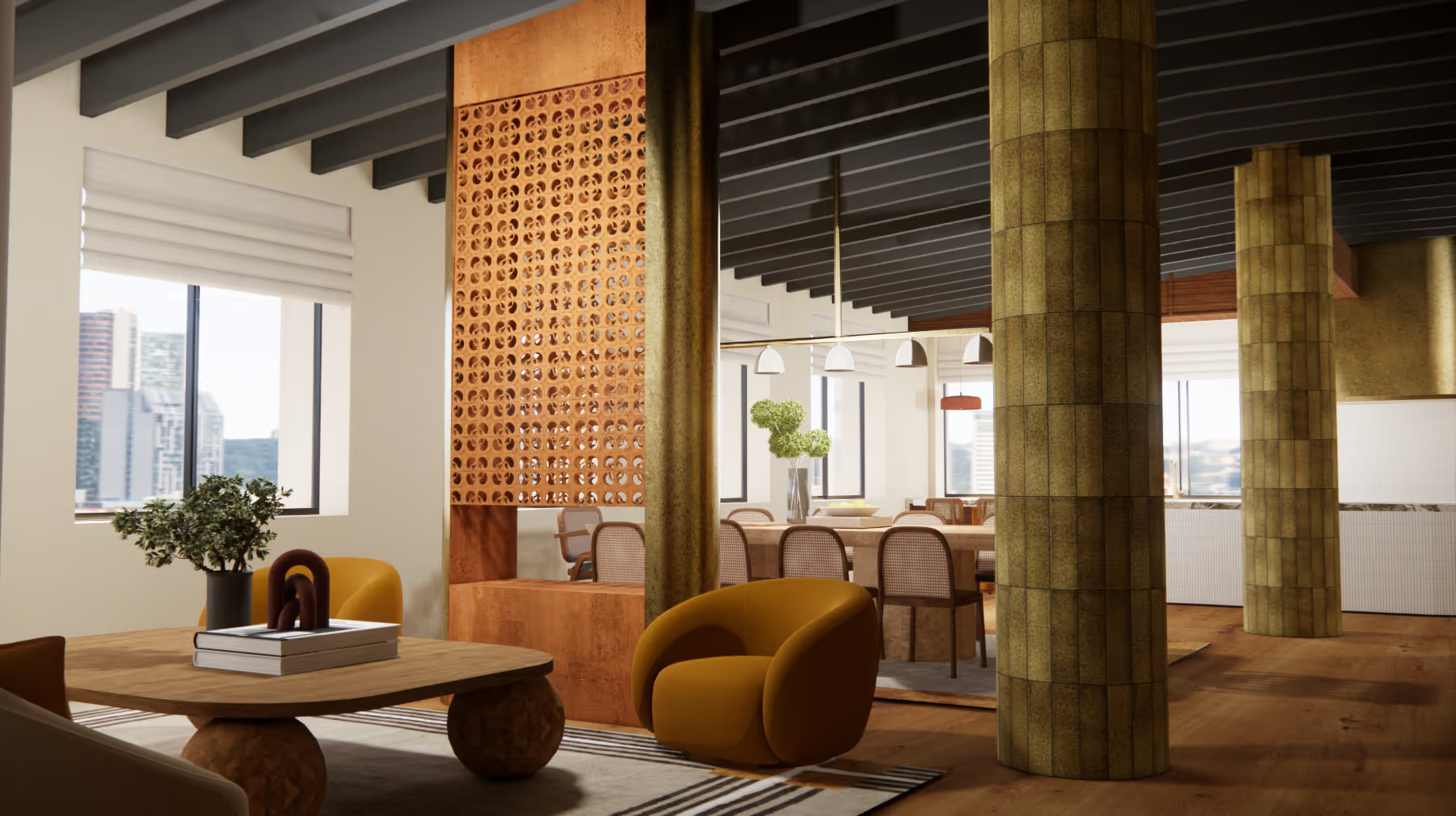
The Industry-Focused Projects You'll Learn
In this accelerated two-year degree, you'll complete six industry-focused projects in the workshop subjects that mirror the real briefs faced by today's leading interior designers. Each trimester builds toward a major end-of-trimester project, progressing in scale and complexity from residential to commercial design.
Trimester One — Residential Foundations
Students design a primary bedroom, ensuite and walk-in wardrobe, incorporating trend forecasting alongside foundational spatial planning and documentation skills.
Trimester Two — Luxury Residential Apartment Design
Students design a full luxury residential apartment, developing their skills in materiality, layout and high-end finish specification.
Trimester Three — Multi-Space Interior Design
Students take on a multi-space interior design project with a strong focus on advanced colour theory and print, translating a design concept into a cohesive, fully documented residential scheme. Introduction to Revit drafting.
Trimester Four — Commercial Hospitality & Retail Design
Students design a commercial hospitality or retail space, with an emphasis on technical drafting and construction documentation. Further development of Revit drafting skills.
Trimester Five — Commercial Office Design
Students design a commercial office space, balancing brand identity, function and workplace experience. Students define their aesthetic for their Signature Graduate Project.
Trimester Six — Signature Graduate Project
In this final capstone project, students conceive, document and present a complete original interior design project from concept through to a finished, presentation-ready portfolio, exhibited at the annual Graduate Exhibition.

Interior Design is one of the most versatile qualifications in the design industry. Our graduates go on to work as Interior Designers across residential, commercial and corporate projects, plus a wide range of related creative and technical fields.
GRADUATES GO ON TO WORK AS
Design & Studio Practice
Interior Designer / Spatial Designer / Design Manager
Product & Materials
Furniture Designer / Interior Product Designer / Textile Designer / Model Maker
Commercial & Specialist
Commercial Designer / Hospitality Designer / Showroom Manager / CAD Engineer
Media & Creative
Lighting Designer / Set Designer (TV & Theatre) / Interior Stylist (Magazines) / Exhibition Designer
Whatever direction you take, you'll graduate with a professional portfolio and the industry-ready skills to back it, from concept and design through to production and delivery.
FEATURED ALUMNI

With purpose-built design campuses in Sydney, Melbourne and Brisbane, Whitehouse students work within professional-standard environments designed around the way the industry actually operates. Not lecture halls, but studios, workshops and resources you'll use in your specialisation every week.
Professional design studios
Fully-equipped studios and computer labs give you the space to move between manual and digital design methods - from technical drawing to 3D designs to digital documentation using industry-standard tools such as SketchUp, AutoDesk Revit. Every interior design student receives free access to these tools for the duration of their studies (Revit is normally about $4.4k per year).
Adobe Creative Cloud suite
Every student receives free access to the full Adobe Creative Cloud suite, giving you the same tools used across professional styling, editorial and creative direction. From week one you'll work in Photoshop, Lightroom, InDesign and Illustrator.
Industry partnerships and sourcing network
Interior Design happen through relationships, and Whitehouse connects students to the network professionals rely on. Across your projects you'll engage with industry suppliers, hire companies, fabric and materials specialists, showrooms and brand partners, learning how to source, negotiate and pull together everything an interior design project demands. Access to industry specialists means the briefs you work on mirror real production conditions, so you graduate already knowing how to build and manage the collaborations behind a professional creative outcome.
Research services
Interior Design students draw on industry-grade trend-forecasting services and a specialist design library, developing the research rigour behind every strong creative decision, from mood and colour direction to sourcing and concept.
Whitehouse continually updates and expands its resources to ensure every student has extensive design research support throughout their degree.

DOMESTIC FEES
All Design courses are FEE-HELP eligible for domestic students. No upfront payment for tuition fees needed if eligible.
|:----|:----|
|Trimester Tuition Fee (full-time study)|$14,610|
|Indicative Average Unit Fee (5 units)|$2,922|
Fees exclude course materials.
INTERNATIONAL FEES
See International section for information on international fees.
HOW TO APPLY
To apply for the Bachelor of Design with specialisation in Interior Design, submit a direct application through the Whitehouse Institute of Design website.
Whitehouse has no application fees.
ENTRY REQUIREMENTS
Domestic
* **Academic:** Completion of year 12 or equivalent
* **Design Meeting:** All applicants attend a Design Meeting
* **Portfolio:** All applicants provide a portfolio
See link below for full entry requirements.
INTERNATIONAL
In addition to standard entry requirements, international students must have a minimum level of English language skills as well as a valid and appropriate visa for studying in Australia. See link below for full entry requirements.
IMPORTANT DATES
Applications for Whitehouse's Bachelor of Design with specialisation in Interior Design are open year-round, with three main intakes each year - February, June and September. Applications typically open within 6 to 12 months of the intake commencing. We recommend applying early to secure your preferred campus and start date.
There's a lot of overlap between our Digital Design subjects and graphic design. The Digital Design subject is best described as a graphic design course within your degree. You'll develop core graphic design principles and skills using the Adobe Creative Cloud suite, including Photoshop, Lightroom and InDesign, applied to photography, editorial layout, digital imaging and portfolio creation. The difference is context: rather than studying graphic design in isolation, you'll apply these skills directly to your interior design projects, learning how to describe, develop and market your creative work across both print and digital formats.
The creative portfolio is a selection of your best work, which demonstrates your creative potential. A portfolio usually consists of between 4-6 examples, and can use a variety of mediums which may include illustration, digital design, photography, film, creative writing, textile design, fine artworks and other evidence as appropriate to your chosen specialisation. Whitehouse uses your portfolio to assess your creative potential for success in the Bachelor of Design. We look at how your work demonstrates:
- An understanding of design, a connection with the current design industry and innovation in your creative thinking.
- A desire to learn and the ability to investigate and develop ideas independently.
If you do not have a Creative Portfolio, or have questions about yours, call us on 1300 551 433 or email study@whitehouse-design.edu.au to talk to us.
Whitehouse offers short workshops throughout the year, which assist students and applicants with their portfolio development. We recommend anyone considering a career in design or applying for the Bachelor of Design, to attend a workshop with us.
Details of all of Whitehouse's Workshops can be found here:
To assist you in your tertiary level design studies, recommended year 11 and 12 subjects include: Design & Technology, Visual Arts, Visual Communication, Textiles & Design, Modern History or Ancient History.
Whitehouse does not have any compulsory pre-requisite subjects.
Whitehouse offers a Certificate III in Design Fundamentals (VET for Secondary School Students) course, which offers its graduates direct entry into the Bachelor of Design at Whitehouse. Students can take this course in Year 10, 11 or 12 of High School.
Absolutely, we are here to help. We recommend meeting with us, giving us a call or coming in for a tour. You can do any of those by clicking on the links below.
Call now 1300 551 433
Email us study@whitehouse-design.edu.au
All Whitehouse courses now have no ATAR requirement as an ATAR does not assess how well a student will succeed creatively.
If you have been made an offer of enrolment but you are not quite ready to commence study, you may defer commencement of studies until the next intake without the need to reapply. For more information on application, enrolment or deferral, you can discuss your options with Admissions.
ACADEMIC CREDIT / RECOGNITION OF PRIOR LEARNING (RPL)
Credits for single subjects may be awarded to accredited subjects previously undertaken at another education provider and/or relevant industry experience.
To apply for Academic Credit:
- Download and complete the Application for Academic Credit
- Fill in the form including all subject titles and descriptions of the units for which you are applying for RPL
- Submit completed form with supporting documentation and evidence to Whitehouse Institute
ADVANCED STANDING
Advanced Standing may be awarded to students who have completed courses in a similar field of study. Depending on the level of study completed, you may be eligible to receive direct articulation into study period two, three or four of the Bachelor of Design. Download or request the Application for Direct Entry - submit with your current/previous qualification and transcript of academic results. If advanced standing is awarded the length of your study may be reduced.
For more information on Academic Credit and Advanced Standing, simply contact Whitehouse Admissions or discuss during your Design Meeting.